Documentary Production: From Idea to Screen, How Stories Come Alive

A strong documentary rarely announces itself as important. It reveals itself gradually as images linger and voices pause. Meaning takes shape in the space between fact and feeling. That is where documentary production truly resides, not in equipment or schedules, but in judgment, restraint, and deliberate choice.
This field has expanded rapidly over the last decade. Streaming platforms reshaped demand. Nonprofits rely on film to explain work that statistics alone cannot. Audiences, increasingly skeptical, expect honesty rather than polish. Yet many explanations of documentary production still focus on tools instead of thinking. That gap matters.
What follows is not a checklist. It is a closer look at how documentaries move from idea to screen, and why documentary storytelling demands a different kind of discipline than most media work.
Where Documentary Production Really Begins
Ideas That Refuse to Stay Abstract
Documentary production often starts with a problem, not a pitch. Something unresolved. A question without a clean answer. It may be a social contradiction, a community under pressure, or a system that behaves differently on paper than it does in practice.
Strong projects usually resist summarization early on. If the idea feels neat, it may be premature. It appears that many impactful documentaries begin with uncertainty rather than confidence, allowing room for discovery.
Research at this stage is less about facts and more about context. Who has already spoken on this issue? Who has not? What assumptions are being repeated without examination?
Documentary Storytelling Is Built, Not Found
Structure Before Style
There is a common misconception that documentary storytelling is purely observational. In reality, structure is doing constant work, even when invisible.
Decisions emerge early. Whose perspective leads? Where tension is allowed to sit unresolved? Which moments earn silence? These are narrative choices, even if no narrator ever appears.
Documentary production that ignores structure often ends with compelling footage and no clear film. Editing cannot solve every structural weakness introduced during development.
Pre-Production as Ethical Preparation
Access Is a Responsibility
Pre-production in documentary production is frequently underestimated. It is not only scheduling and budgeting. It is also an ethical alignment.
Gaining access to individuals or communities carries an obligation. Consent is ongoing, not a single form. Power dynamics matter, especially in nonprofit video production, where subjects may feel pressure to participate.
It is believed that films built on long-term trust tend to reveal more nuanced truths than those assembled quickly. That trust must be earned before cameras roll.
Production Is Where Control Fades
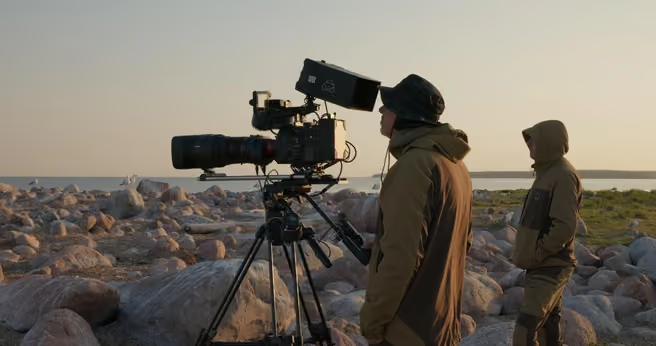
Filming Reality Without Forcing It
Once production begins, certainty disappears. Plans adjust. Interviews shift tone. Events unfold out of sequence.
Documentary production during this phase requires restraint. Knowing when not to film can matter as much as knowing when to keep rolling. Excess footage does not equal depth.
Sound, often overlooked, carries emotional weight. Ambient noise, pauses, overlapping speech. These details ground documentary storytelling in lived experience rather than explanation.
Editing Is Where Meaning Emerges
The Story Reveals Itself Late
If production gathers material, post-production defines intention. This is where documentary production becomes most interpretive.
Editors do not simply assemble scenes. They argue with them. Sequences are tested, removed, and rebuilt. Sometimes the central question of the film changes entirely at this stage.
It is tempting to impose clarity too quickly. Yet many documentaries benefit from allowing complexity to remain visible. Ambiguity, handled carefully, can signal respect for the audience.
Purposeful Films and the Limits of Objectivity
Balance Without False Neutrality
Purposeful films often face scrutiny for having a point of view. That criticism misunderstands the form. All documentaries frame reality. The issue is not bias, but transparency.
Nonprofit video storytelling, in particular, sits at the intersection of advocacy and observation. The challenge is avoiding simplification while still communicating urgency.
Effective documentary production acknowledges its perspective while grounding claims in verifiable experience. It shows rather than insists.
Distribution Shapes the Final Film
Audience Changes Meaning
A documentary screened in a community center functions differently from one released online. Context matters.
Distribution decisions influence runtime, pacing, and even narrative emphasis. Shorter cuts may serve nonprofit video production goals better than feature-length releases in some cases.
It is likely that the most effective documentaries are not those that reach the largest audience, but those that reach the right one.
Common Gaps in Documentary Production Today
What Many Guides Miss
After reviewing leading resources on documentary production, several gaps stand out:
- Limited discussion of ethical follow-through after release
- Overemphasis on gear instead of editorial judgment
- Little acknowledgment of uncertainty during development
- Minimal focus on nonprofit-specific constraints and responsibilities
These omissions matter. Documentary storytelling is as much about what happens after the screen fades to black as what appears before it.
Measuring Impact Without Reducing Meaning
Beyond Views and Shares
Impact is often reduced to metrics. That approach is convenient, but incomplete.
For nonprofit video storytelling, impact may show up as policy attention, donor understanding, or community validation. Some outcomes take months or years to surface.
Documentary production teams increasingly track qualitative feedback alongside numbers. Letters. Follow-up conversations. Changes in how an issue is discussed publicly.
A Brief Look at How Narratives Inc. Approaches the Process
Narratives Inc. works within the nonprofit video production space by prioritizing long-term collaboration, ethical access, and story-first development. Their focus on documentary storytelling emphasizes lived experience over spectacle, allowing purposeful films to remain grounded without losing emotional clarity.
Partner with Narratives Inc. to create nonprofit films that honor lived experience, strengthen credibility, and deliver stories with lasting impact.
Documentary Production Is an Ongoing Conversation
The idea that a documentary is finished once released feels outdated. Films now live in fragments, discussions, classrooms, and campaigns.
Documentary production does not end at distribution. It evolves through response. Sometimes the most meaningful chapters happen after audiences engage, reinterpret, or challenge what they have seen.
That tension is not a flaw. It is the point.
Frequently Asked Questions
What makes documentary production different from other video formats?
It prioritizes real events and ethical responsibility over controlled messaging.
How long does documentary production usually take?
Timelines vary widely. Many projects develop over months or years.
Is documentary storytelling always scripted?
No. Structure exists, but outcomes remain open.
Why do nonprofits rely on documentary storytelling?
It conveys complexity and human context better than summaries or data alone.
Can purposeful films still be objective?
They can be fair and transparent, even when guided by values.

.avif)