Impact Investing: Partnering for a Better Future

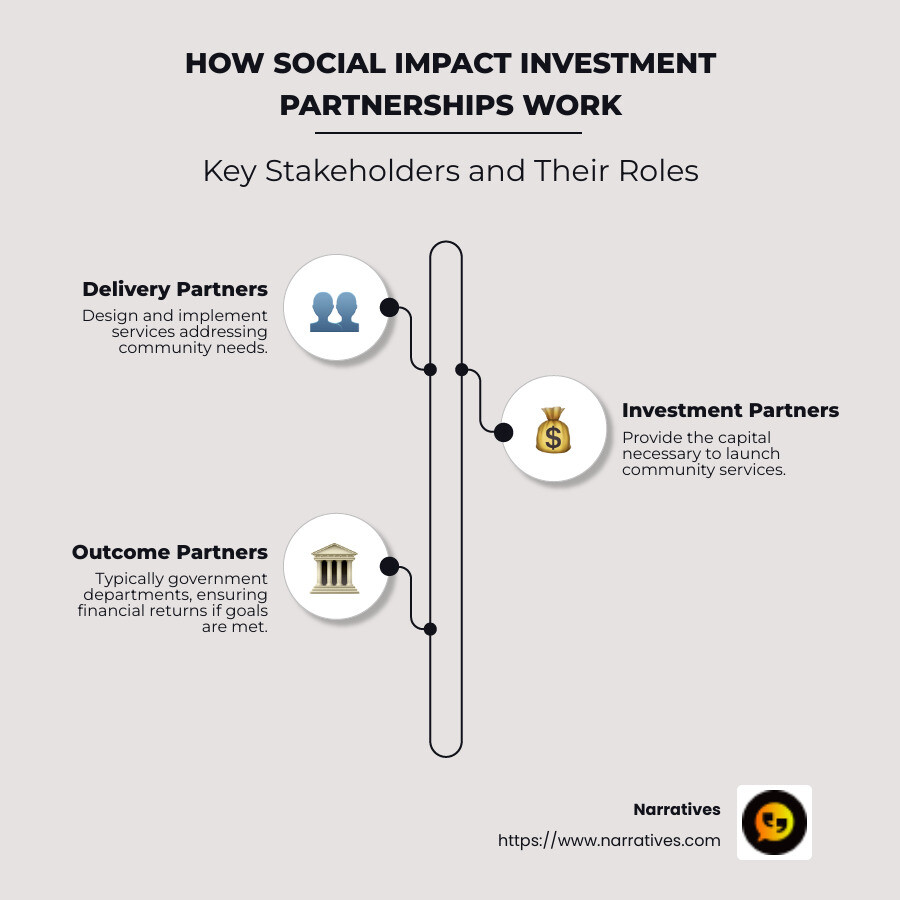
Social impact investment partnership is a key strategy that combines financial returns with meaningful societal benefits. It involves three main players: Delivery Partners, Outcome Partners, and Investment Partners working together to address social issues like youth unemployment or health disparities. Here's a quick snapshot of how it functions:
- Delivery Partners: Design and implement services for community needs.
- Investment Partners: Provide the needed capital to launch these services.
- Outcome Partners: Typically government departments or organizations covering financial returns if set goals are met.
Through such partnerships, we harness the strengths of public, private, and social sectors, aiming for sustainable change. This blended approach ensures that financial resources are used efficiently, promoting social advancement and financial gains for investors.
"As a society, we face problems too large and complex to address with grant capital alone."
This model goes beyond traditional philanthropy by enabling a measurable social impact, making it an effective tool for values-driven organizations aspiring to amplify their missions. Social impact investment partnerships are a game-changer, blurring the lines between business as usual and the urgent need for positive societal impact.
Understanding Social Impact Investment Partnerships
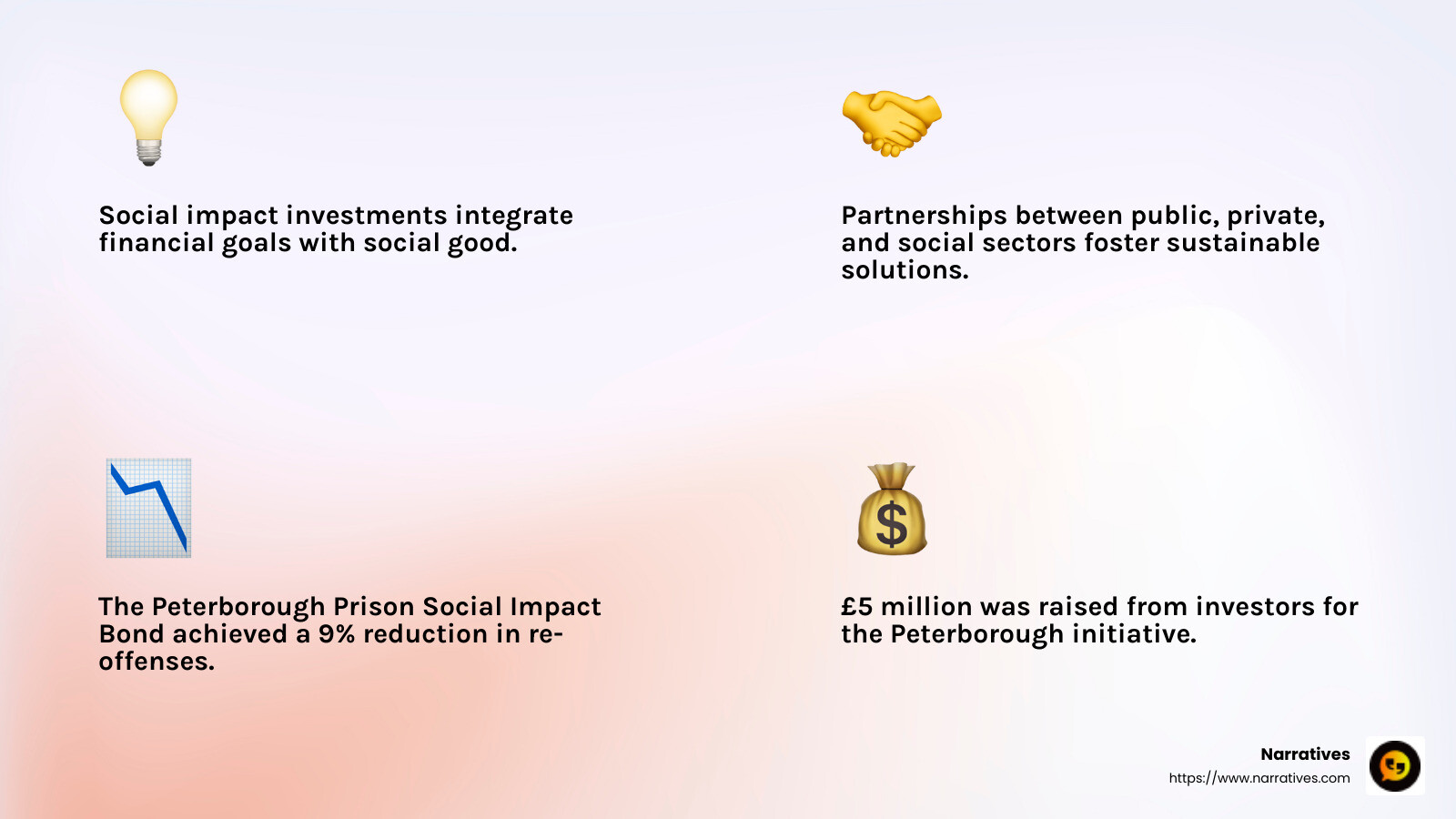
Social Impact Investment Partnerships are a modern approach to tackling societal challenges. They blend financial goals with social good, creating a win-win for communities and investors. Let's explore what makes these partnerships tick:
Innovative Investments
At the heart of these partnerships is innovation. They bring together diverse sectors—public, private, and social—to create solutions that are both effective and sustainable. For instance, the successful Social Impact Bond at Peterborough Prison in the UK demonstrated how innovative funding can reduce re-offending rates and deliver financial returns. This model raised £5 million from investors, achieving a 9% reduction in re-offenses compared to a control group.
The Power of Partnerships
These partnerships thrive on collaboration. By pooling resources and expertise, they tackle issues that are too complex for any single entity to solve alone. Consider the Delivery Partners, who design and implement community services. They work hand-in-hand with Investment Partners providing capital and Outcome Partners ensuring financial returns when goals are achieved. This synergy leads to impactful and measurable change.
A Pathway to Sustainable Change
Social impact investment partnerships are more than just investments; they're a commitment to long-term societal change. The Social Finance Impact First Fund exemplifies this, having mobilized over $400M towards projects that foster economic development and well-being. This approach not only addresses immediate needs but also lays the groundwork for a sustainable future.
By integrating innovative investments and fostering strong partnerships, social impact investment partnerships are reshaping how we approach social challenges. They provide a blueprint for using financial resources to drive meaningful, lasting change in our communities.
Key Principles of Impact Investing
Impact investing is not just about putting money into projects. It's about creating real change. Here are the key principles that guide this approach:
Additionality
Additionality means investing in projects that might not get funding from traditional sources. These are often seen as too risky or unprofitable. For example, the MacArthur Foundation focuses on opportunities that conventional investors shy away from, bridging financing gaps for social and environmental impact. This ensures that impactful initiatives have the resources they need to succeed.
Mobilization
Mobilization is about using investment to open up more funds from other sources. When one investment draws in additional capital, the impact multiplies. By investing strategically, organizations can attract more investors to join the cause. This principle is key to scaling up efforts and achieving broader change.
Innovation
At the heart of impact investing is innovation. This involves supporting enterprises that create new solutions to social and environmental problems. For instance, investing in clean energy startups or educational technology can lead to groundbreaking advancements. Impact investors look for novel ideas that can transform communities and markets.
Inclusion
Inclusion is about extending opportunities to historically marginalized or underserved communities. It ensures that investments drive economic progress for everyone, not just a select few. This principle focuses on empowering communities, fostering diversity, and promoting equity in financial systems.
Impact investing is a powerful tool for change, guided by these principles. By focusing on additionality, mobilization, innovation, and inclusion, investors can make a real difference in the world.

The Role of Government and Policy in Social Impact Investment
Government and policy play a crucial role in shaping social impact investment partnerships. By setting the right frameworks and incentives, they can drive significant change in how investments are made for social good.
Government Policy
Government policy is vital in supporting the social impact investing market. Policies can create an environment where social investments thrive. For instance, by offering tax incentives or subsidies, governments can encourage private investors to fund projects that address social issues like housing, health, and education.
Moreover, governments can develop strategies that integrate social impact investments across different sectors. This can maximize the benefits of such investments, ensuring they contribute to national priorities and deliver measurable social outcomes.
Social Outcomes Contracts
A key tool in this space is the social outcomes contract. These contracts allow governments to pay for actual positive changes in people’s lives. Instead of funding services directly, governments only pay when specific outcomes are achieved. This approach ensures that taxpayer money is used efficiently, funding projects that deliver real results.
An example of this is the Peterborough Prison social impact bond in the UK, which successfully reduced re-offending rates. Investors were rewarded only when the project met its targets, demonstrating the effectiveness of outcome-based funding.
Social Lending
Social lending is another important aspect. It involves providing loans to projects that have a social impact. Governments can support social lending by working with financial institutions to lower the risks associated with these loans. This can help open up private capital for projects that might not otherwise receive funding.
In the U.S., community development financial institutions (CDFIs) are essential in providing these loans. They serve as the financial backbone for many communities, offering pathways to economic mobility and opportunity.
By leveraging policies, outcome-based contracts, and social lending, governments can create a supportive environment for social impact investments. This not only attracts private investment but also ensures that resources are used effectively to tackle pressing social issues.
Successful Models of Social Impact Investment Partnerships
When it comes to social impact investment partnerships, there are several successful models that stand out. These models not only aim to generate financial returns but also prioritize meaningful social and environmental outcomes.
Impact-First Investments
Impact-first investments are a powerful tool for creating positive change. These investments prioritize social and environmental impact over financial returns. According to Social Finance, these investments blur the line between giving and investing, offering a scalable approach to using capital for good.
Laura Lauder, from the Laura and Gary Lauder Family Venture Philanthropy Fund, highlights the transformative potential of impact-first investments. She believes they are a "game changer" because they allow donors to support the causes they care about while having the potential to recover and reuse those charitable dollars.
Catalytic Capital
Catalytic capital is another key player in the impact investing landscape. It is designed to take on risks that other types of capital cannot. This kind of funding is crucial for open uping additional resources and attracting more traditional investments to projects that might otherwise be overlooked.
The MacArthur Foundation, a leader in the field, emphasizes the role of catalytic capital in strengthening the global impact investment ecosystem. By increasing knowledge and awareness, they help ensure that catalytic capital is used effectively to drive social change.
Community Development Financial Institutions (CDFIs)
Lastly, community development financial institutions (CDFIs) are vital in supporting underserved communities. They provide affordable loans and financial services to areas that traditional banks often ignore. CDFIs play a significant role in fostering economic development and opportunity, especially in marginalized communities.
In the U.S., CDFIs have been instrumental in providing financial pathways for individuals and small businesses, contributing to community revitalization and economic mobility.
These models demonstrate the diverse approaches to social impact investment partnerships. By focusing on impact-first investments, leveraging catalytic capital, and supporting CDFIs, investors can drive meaningful change and create a better future for communities around the world.
Frequently Asked Questions about Social Impact Investment Partnerships
What is a social impact investment partnership?
A social impact investment partnership is a collaboration between investors, organizations, and sometimes governments to create positive social or environmental effects while also generating financial returns. These partnerships focus on solving societal issues like healthcare, education, and clean energy. By investing in projects that aim for measurable change, these partnerships ensure that the capital not only grows but also benefits communities.
How do social impact bonds work?
Social impact bonds (SIBs) are unique tools in impact investing. Despite the name, they aren't traditional bonds. Instead, they are contracts with the public sector to fund projects that aim for better social outcomes. Investors provide the upfront capital for a project, and if the project achieves its goals, the government or governing body repays the investors with a return.
For example, the Peterborough Prison SIB in the UK aimed to reduce re-offending rates. It successfully decreased repeat offenses by 9%, surpassing its target. As a result, investors received a return on their investment. This model shows how SIBs can drive social change while offering financial incentives.
How can impact investing improve public services?
Impact investing can significantly improve public services by ensuring funds are used effectively to achieve genuine positive changes. One approach is commissioning for outcomes, where the government pays for real, measurable improvements in areas like health, housing, and education.
By focusing on results rather than activities, this method encourages innovation and efficiency in public services. For instance, using social outcomes contracts, as supported by Social Finance, ensures that taxpayer money is spent on initiatives that deliver tangible benefits to people's lives. This results in more effective public services and better outcomes for communities.
Conclusion
In the dynamic world of social impact investment partnerships, the role of digital storytelling cannot be overstated. At Narratives, we specialize in elevating the voices of non-profits and purpose-driven organizations. By using the power of storytelling, we help these organizations not only share their impact stories but also inspire action, build trust, and increase their visibility.
Digital storytelling is a powerful tool that transforms complex data and achievements into relatable, engaging narratives. It allows non-profits to connect emotionally with their audience, turning abstract concepts into stories that resonate on a personal level. This connection is crucial for non-profits striving to communicate their mission and impact effectively.
Narratives is committed to partnering with these organizations, providing them with high-quality, emotionally resonant video and multimedia content. Our goal is to help non-profits share their stories in a way that not only informs but also inspires change. By doing so, we contribute to the growth of a more inclusive and equitable society.
We invite you to learn more about how we can help your organization amplify its impact through storytelling. Visit our Clients page to find how we can partner with you to create compelling narratives that drive social change.
Together, we can make a difference, one story at a time.


.avif)