The Rise of Social Impact Entertainment (SIE) and Why It Matters

.avif)
Metrics alone don’t explain why some stories travel further than others. A policy report may have flawless data, yet a six-minute phone-shot narrative can shift public opinion overnight. Today’s social impact campaigns mirror mainstream media, with audiences expecting narrative arcs, character depth, and cinematic pacing. What once appeared in nonprofit newsletters now shows up on streaming platforms and vertical video feeds. The question is no longer whether storytelling belongs in advocacy. It’s how intentionally it’s designed.
Understanding these social impact entertainment trends requires stepping back—not to admire the hype, but to examine what is actually changing.
What Is Social Impact Entertainment?
Moving Beyond Awareness Campaigns
The SIE definition is often reduced to “entertainment with a purpose.” That explanation is too thin. Social impact entertainment blends storytelling with measurable goals. It engages first, informs second, and ideally inspires tangible action. Unlike traditional public service announcements that simply push information, it invites emotional participation, highlighting a clear difference.
Unlike standard cause marketing, the social impact entertainment definition assumes collaboration between creators, nonprofits, and sometimes commercial studios. The content is designed for reach and relevance, not just compliance or moral appeal.
Core Attributes of SIE
Several characteristics appear consistently across social impact entertainment trends:
- Story-first structure rather than issue-first framing
- Human protagonists with lived experience
- Clear pathways for audience action
- Metrics tied to real outcomes, not vanity views
Purpose sits at the center, but entertainment mechanics drive distribution. That dual focus explains why the SIE definition continues to evolve.
Documentaries such as 13th or campaign-driven film series tied to criminal justice reform illustrate the shift; they were not positioned as educational supplements, but as cultural events.
The Evolution of SIE From Documentary to Feed
Early Roots in Advocacy Film
Long-form documentaries have shaped nonprofit media for decades, exposing injustice and overlooked communities. Distribution was once limited to festivals, public TV, and community screenings. Streaming platforms changed that, letting advocacy narratives reach global audiences and shifting engagement from in-person Q&As to hashtag campaigns.
The Shift to Short Form
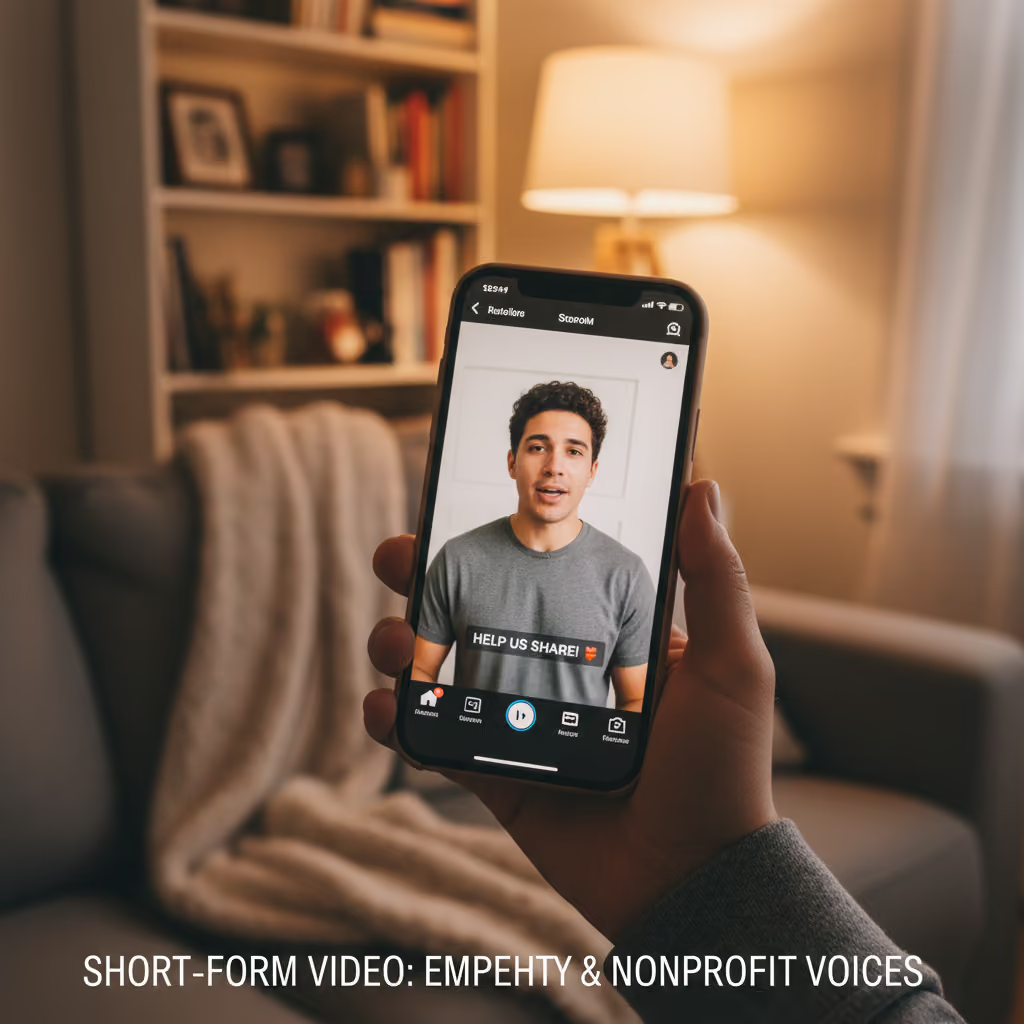
Mobile platforms like NowThis and ATTN: redefined impact storytelling for social feeds. Short, captioned, emotionally direct videos resonated with younger audiences. Viewers engaged more deeply than with traditional ads, likely because these clips felt less transactional. Entertainment framed around real people tends to bypass resistance. It does not appear as a pitch.
This shift defines current social impact entertainment trends. Content is shorter. Distribution is algorithmic. Audience feedback is immediate. Nonprofit media trends now depend on platform literacy as much as storytelling craft.
Why Social Impact Entertainment Works
Emotion and Memory
Cognitive research suggests narrative activates more regions of the brain than raw data alone. While exact behavioral outcomes vary, stories appear to increase recall and empathy, which matters when seeking donations or policy shifts.
Entertainment lowers defenses. Viewers enter for the story, not the statistic. Once invested, they are more open to new perspectives.
Campaigns addressing mental health stigma or reentry after incarceration have demonstrated measurable increases in signups and community event attendance following narrative video releases. The mechanism is rarely accidental. It’s planned.
Organizations exploring these social impact entertainment trends often underestimate the strategic layer behind them. Effective projects involve narrative mapping, audience segmentation, and distribution planning before a camera is lifted.
A professionally guided storytelling strategy can strengthen that process. Structured narrative consulting helps align creative direction with measurable objectives, rather than leaving impact to chance. While it may not guarantee virality, it does increase coherence.
SIE Across Platforms
Streaming Versus Social
Streaming platforms provide depth. Social platforms provide scale. Both influence nonprofit media trends, but in different ways.
Long-form content allows complex issues to breathe. Social feeds demand compression. A ninety-minute documentary can explore systemic inequality. A thirty-second vertical video distills one human moment.
Short-form storytelling on TikTok and Instagram often outperforms static graphics. Viewers respond to faces, voices, and micro-expressions, and even imperfect footage can beat polished infographics.
Strategic Adaptation
For nonprofits and mission-driven creators, adapting to platform norms is not optional. Captioning, pacing, and format matter. So does understanding what prompts interaction rather than passive scrolling.
If your team is exploring short-form strategy or training around video storytelling systems, consider investing in structured development rather than experimentation alone. Thoughtful execution tends to compound over time.
Current social impact entertainment trends suggest audiences reward authenticity paired with clarity, not noise.
Metrics That Matter
Beyond Views
High view counts may look impressive, but they rarely tell the full story.
Impact-oriented campaigns increasingly track downstream indicators:
- Donation spikes after content release
- Volunteer registrations
- Petition signatures
- Policy engagement or public comment participation
This measurement layer reflects a maturation in nonprofit media trends. Vanity metrics are losing influence.
Building an Impact Framework
Effective SIE initiatives often begin with goal mapping. What behavior change is realistic? What timeframe makes sense? Attribution is complex when campaigns span multiple channels. A practical framework uses baseline data, benchmarks, and post-release evaluation. While it can’t capture every ripple, it ensures accountability. Organizations that treat storytelling as infrastructure, not decoration, are better able to measure meaningful outcomes.
Tools and Technology Shaping the Future
Artificial intelligence now assists with editing, captioning, and personalization. Distribution platforms enable micro-targeting. Analytics dashboards provide near real-time performance insights.
At the same time, technology can dilute authenticity if misused. Automated content without human narrative sensitivity often feels hollow.
The future of social impact entertainment trends likely depends on balance. The future depends on scalable systems guided by editorial judgment. Nonprofits often use video editing software, audience analytics, and content calendars, but tools alone don’t create resonance; strategy does.
Human Stories Drive Real Social Impact
Mission-driven storytelling organizations support this shift. Narratives Inc., a nonprofit multimedia network, focuses on first-person stories that elevate underrepresented voices while aligning distribution with measurable social impact.
Such platforms illustrate how the SIE definition extends beyond isolated films, incorporating ecosystem thinking. Content creation, partnership development, audience engagement, and funding structures work together.
Social impact entertainment trends suggest that audiences are not fatigued by serious topics. They are fatigued by abstraction. Concrete human stories still cut through.
Partner With Narratives Inc.—Amplify Underrepresented Voices Through Impactful Storytelling.
Cultural and Business Forces Driving Growth
Several forces drive social impact entertainment: brands align with purpose, streaming platforms seek unique content, and younger audiences demand transparency and values. Nonprofits mirror this shift, moving from annual reports to serialized storytelling. Foundations request multimedia deliverables alongside impact data.
The growth of social impact entertainment trends may not be linear. Funding cycles fluctuate. Platform algorithms change. Still, the integration of narrative and mission appears durable.
The New Ecosystem of Purpose-Driven Entertainment
Social impact entertainment is no longer peripheral. It sits at the intersection of media, advocacy, and community engagement.
For nonprofits, creators, and mission-aligned partners, the opportunity is clear. Develop a narrative strategy with intention. Measure outcomes beyond impressions and invest in capacity, not trends. To deepen your approach, download our Social Impact Entertainment Playbook and see how structured storytelling drives measurable change. Audiences crave stories that matter, seeing themselves and others in human complexity—and that expectation is here to stay. This may be the quiet shift at the heart of it all.