Storytelling Secrets: 26 Techniques to Enhance Your Narrative

Open uping the Power of Storytelling
Narrative storytelling techniques are the magic wand behind every impactful message. They are essential tools, whether you're a non-profit trying to amplify your mission, a brand championing social justice, or a media outlet forming the backbone of compelling content.
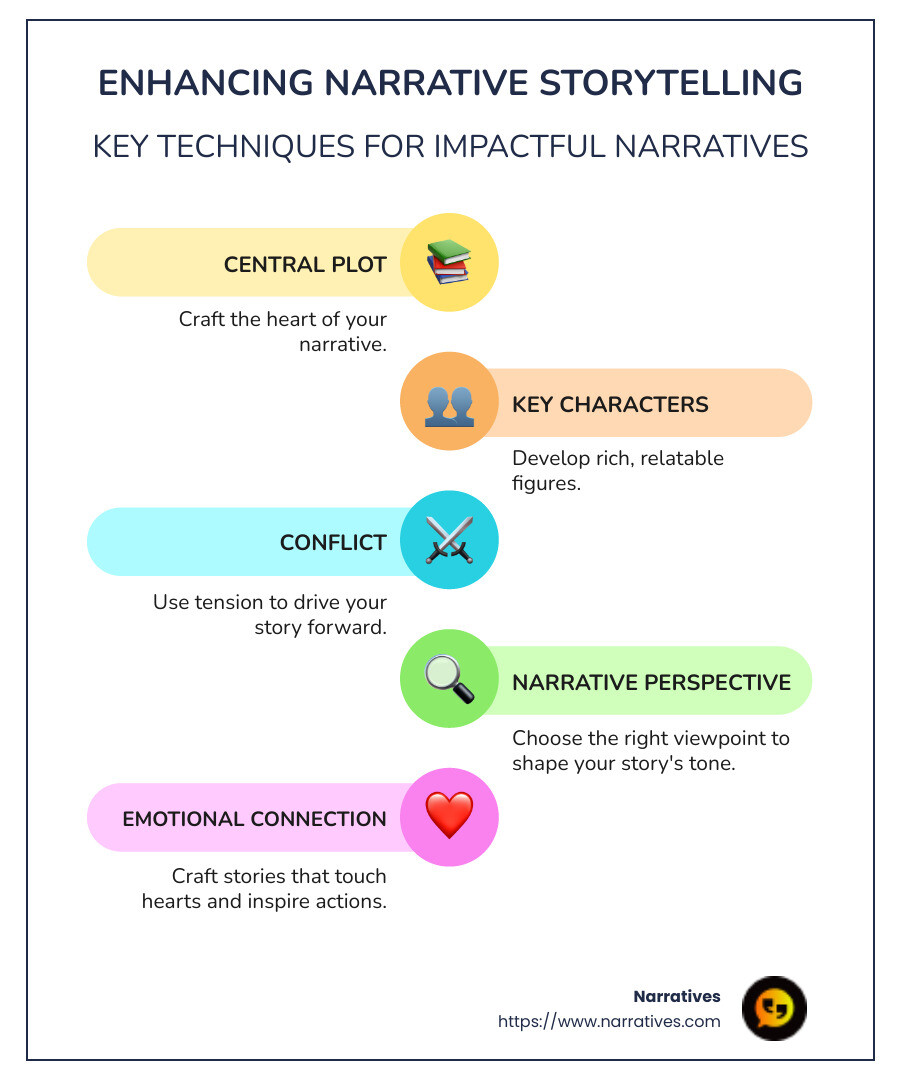
Here's a quick glimpse into some powerful narrative techniques you can use to lift your story:
- Central Plot: Craft the heart of your narrative.
- Key Characters: Develop rich, relatable figures.
- Conflict: Use tension to drive your story forward.
- Narrative Perspective: Choose the right viewpoint to shape your story's tone.
Storytelling isn't just about conveying information; it's about crafting a narrative that touches hearts and inspires actions. An effective story can bypass barriers, engage audiences, and ignite change.
In today's world, captivating an audience's attention is a challenge. Cold statistics and flat presentations just aren't enough. Instead, weaving data into narratives that capture imaginations is vital. As said, “Every great brand tells a story. Every great pitch deck tells a story. Every great career is a story.”
This article solves the secrets of storytelling methods that can transform your message into a narrative masterpiece. Whether you're looking to create emotional connections or deliver measurable results, mastering these techniques is key.
Narrative storytelling techniques further reading:
Understanding Narrative Storytelling Techniques
When it comes to crafting a compelling narrative, understanding and utilizing narrative storytelling techniques like backstory, flashback, flash-forward, and foreshadowing can lift your story from good to unforgettable. Let's explore these techniques and see how they can add depth and intrigue to your narrative.
Backstory
Backstory is the hidden layer of your narrative, providing essential context for your characters and plot. It's the history that shapes your characters' motivations and decisions. For instance, in J.K. Rowling's Harry Potter series, Harry's backstory of losing his parents to Voldemort adds emotional weight to his journey and explains his deep-seated mission to defeat evil.
Why it matters: A well-crafted backstory can make your characters more relatable and your plot more engaging. It gives your audience a reason to care about what happens next.
Flashback
A flashback is a narrative technique that takes the audience back in time from the current point in the story. This technique is perfect for revealing critical information about a character's past or uncovering hidden motivations. Think of it like a puzzle piece that completes the picture.
Example: In the film The Godfather Part II, flashbacks are used to show Vito Corleone's rise to power, enriching the audience's understanding of the Corleone family's legacy.
Why it matters: Flashbacks can add layers to your story, providing depth and complexity that keep the audience engaged.
Flash-Forward
Flash-forward is the opposite of a flashback. It propels the narrative into the future, offering a glimpse of events yet to come. This technique can build suspense and anticipation, leaving the audience eager to see how the narrative unfolds to reach that future point.
Example: In the TV series Breaking Bad, flash-forwards are used to show the eventual downfall of Walter White, creating a sense of inevitability and tension throughout the series.
Why it matters: Flash-forwards can create a sense of urgency and keep your audience on the edge of their seats.
Foreshadowing
Foreshadowing is a subtle hint or clue about what will happen later in the story. It's like a breadcrumb trail that leads the audience through the narrative, keeping them guessing and engaged.
Example: In George R.R. Martin's A Song of Ice and Fire, the direwolves found by the Stark children foreshadow the family's fate and the unfolding war in Westeros.
Why it matters: Foreshadowing builds suspense and keeps your audience invested in the story, as they look for connections and anticipate future events.
By integrating these techniques into your storytelling, you can craft a narrative that is not only engaging but also deeply resonant with your audience. These tools help you create a rich mix of story elements that captivate and entertain.
Next, we'll explore 26 techniques to further improve your narrative skills.
26 Techniques to Improve Your Narrative
Monomyth
The hero's journey, or monomyth, is a timeless structure found in stories from The Lion King to Star Wars. It involves a hero leaving home, facing trials, and returning with newfound wisdom or a reward. This structure not only guides traditional tales but also modern narratives, providing a framework that resonates across cultures and times.
Why use it? It taps into universal themes of growth and change, making your story relatable and compelling.
Nested Loops
Nested loops involve layering narratives to improve the core message. Start with a story that introduces your main idea, then nest additional stories within it to illustrate and expand upon the central concept. This technique is akin to peeling back layers of an onion, revealing deeper insights with each story.
Example: A speaker might start with a personal anecdote, then share a mentor's wisdom, and finally, return to the personal story, now enriched with new understanding.
Why it works: It keeps your audience engaged and allows for a richer exploration of your theme.
Sparklines
Sparklines contrast the present reality with an ideal world, creating an emotional journey for the audience. This technique highlights problems and envisions solutions, motivating change. It's like painting a picture of "what is" versus "what could be."
Example: Martin Luther King Jr.'s "I Have a Dream" speech uses sparklines to juxtapose racial inequality with a vision of a united future.
Why it matters: It stirs emotions and inspires action, making your message unforgettable.
In Medias Res
Jumping right into the action with in medias res hooks your audience from the start. Begin with a pivotal moment, then rewind to explain how you got there. This technique is perfect for maintaining suspense and engagement.
Example: Zak Ebrahim starts his talk with a shocking revelation about his father, immediately capturing attention before delving into his personal journey.
Why use it? It grabs attention instantly and keeps your audience eager for more.
Converging Ideas
Converging ideas bring together different stories or concepts to form a unified conclusion. This approach shows how diverse paths can lead to a single, impactful outcome.
Example: In a presentation, you might weave together stories of innovation from various fields to highlight a common theme of human ingenuity.
Why it works: It creates "aha" moments, revealing connections that might not be obvious at first.
False Start
A false start disrupts expectations, drawing your audience in with an unexpected twist. Begin with a narrative direction, then shift abruptly to surprise and intrigue.
Example: Start with a seemingly straightforward story, only to reveal a twist that changes everything midway.
Why use it? It captures attention and keeps your audience guessing, enhancing engagement.
Petal Structure
The petal structure involves telling multiple stories around a central concept. Each story is like a petal, contributing to the overall narrative flower. This technique is ideal for exploring various facets of a theme without losing focus.
Example: In a talk about community building, share stories of different neighborhoods, each illustrating a unique aspect of community spirit.
Why it works: It allows for diverse storytelling while maintaining a cohesive message.
By mastering these narrative storytelling techniques, you can craft stories that are not only engaging but also deeply impactful. Whether you're writing a novel, giving a speech, or creating content, these techniques can lift your narrative to new heights.

Advanced Storytelling Techniques
When you're ready to take your storytelling to the next level, these advanced techniques can add depth and intrigue to your narratives. Let's explore Chekhov's gun, cliffhanger, eucatastrophe, and plot twist.
Chekhov's Gun
Chekhov's gun is a principle that every element in a story must be essential. If you introduce a gun in the first act, it should go off by the third. This technique helps you maintain a tight narrative, ensuring that nothing is superfluous.
Example: In a mystery novel, a seemingly trivial detail early on turns out to be the key to solving the case.
Why it works: It keeps your audience attentive, knowing every detail could be significant.
Cliffhanger
A cliffhanger leaves your audience in suspense by ending a scene or chapter at a critical point. This technique is often used in serialized content to ensure viewers or readers return for the next installment.
Example: TV shows like Breaking Bad often end episodes with a character in peril, compelling viewers to tune in next time.
Why use it? It creates anticipation and keeps your audience coming back for more.
Eucatastrophe
Coined by J.R.R. Tolkien, a eucatastrophe is a sudden, positive turn of events when all seems lost. This technique provides a satisfying resolution that uplifts the audience.
Example: In The Lord of the Rings, Gollum accidentally destroys the Ring, saving Middle Earth at the last moment.
Why it matters: It delivers an emotional payoff, turning despair into joy.
Plot Twist
A plot twist is an unexpected development that changes the direction of the story. It challenges assumptions and keeps the audience guessing.
Example: In The Sixth Sense, the revelation about Dr. Crowe's true condition redefines the entire narrative.
Why use it? It adds complexity and surprise, making your story memorable.
By incorporating these narrative storytelling techniques, you can keep your audience engaged and invested in your story. These tools not only improve the plot but also deepen the emotional impact, leaving a lasting impression.
Narrative Techniques in Perspective
Choosing the right perspective is crucial in narrative storytelling. It affects how readers connect with the story and characters. Let's explore three popular narrative techniques: first-person narration, third-person narration, and the unreliable narrator.
First-Person Narration
In first-person narration, the story is told from the perspective of a character within the story, usually the protagonist. This approach creates an intimate connection with the audience, allowing them to experience the character's thoughts and emotions directly.
Example: Mark Twain's Trips of Huckleberry Finn uses Huck as the narrator. His unique voice and perspective offer readers a direct line into his world, making the story feel personal and engaging.
Why it works: It offers a deep dive into the character's mind, fostering empathy and a sense of immediacy.
Third-Person Narration
Third-person narration features an external narrator who describes the events of the story. This perspective can be omniscient, where the narrator knows everything about all characters, or limited, focusing on the thoughts and feelings of one character.
Example: A Song of Ice and Fire by George R.R. Martin employs multiple limited third-person narrators, switching perspectives with each chapter. This technique provides a broad view of the complex world while maintaining personal connections to individual characters.
Why use it? It offers flexibility, allowing for a comprehensive view of the story world while maintaining focus on specific characters.
Unreliable Narrator
An unreliable narrator is one whose credibility is compromised. This technique adds layers of complexity, as readers must question the truthfulness of the account and piece together the actual story.
Example: In Vladimir Nabokov's Pale Fire, Charles Kinbote's narration is filled with personal biases and delusions, challenging readers to discern reality from his skewed perspective.
Why it matters: It creates intrigue and encourages active engagement, as readers must interpret and analyze the narrative critically.
By understanding and applying these narrative storytelling techniques, writers can craft stories that resonate deeply with their audience. Each perspective offers unique strengths and can be used to improve the emotional and intellectual impact of your narrative.
Frequently Asked Questions about Narrative Storytelling Techniques
What are narrative storytelling techniques?
Narrative storytelling techniques are tools that storytellers use to craft compelling stories. These techniques shape how a story unfolds and how it resonates with the audience. They include methods like backstory, flashback, foreshadowing, and many others. Each technique serves a unique purpose, whether it's to build tension, evoke emotion, or reveal character depth.
How can narrative techniques improve storytelling?
Narrative techniques improve storytelling by:
Engaging the Audience: Techniques like In Medias Res hook readers from the start by dropping them into the action.
Adding Depth: Flashbacks and backstories provide context, enriching the narrative and helping the audience understand characters' motivations.
Building Suspense: Foreshadowing hints at future events, keeping audiences on the edge of their seats.
Creating Emotional Impact: Techniques like Sparklines contrast what is with what could be, evoking strong emotional responses.
By employing these techniques, storytellers can craft narratives that are not only engaging but also memorable and impactful.
What is the difference between narrative techniques and narrative elements?
While narrative techniques are specific methods used to tell a story, narrative elements are the fundamental components that all stories share.
Narrative Elements: These include the plot, characters, setting, theme, and conflict. They form the backbone of any narrative.
Narrative Techniques: These are the stylistic choices that improve how the story is told, such as using a false start to subvert expectations or a nested loop structure to layer narratives.
Elements are the building blocks of a story, while techniques are the tools used to construct and embellish it. Understanding the distinction allows storytellers to effectively craft and refine their narratives for maximum impact.
Conclusion
At Narratives, we believe that digital storytelling is more than just a way to share stories—it's a powerful tool for creating real-world impact. By leveraging narrative storytelling techniques, we help non-profits and purpose-driven organizations amplify their voices and drive social change.
Digital storytelling allows us to reach audiences far and wide. It transforms traditional narratives into engaging multimedia experiences that resonate on a deeper emotional level. This is crucial for non-profits, who often need to convey complex social issues in a manner that is both accessible and compelling.
Our commitment to social impact shines through in every story we tell. By focusing on underrepresented voices, we bring attention to important causes and inspire action. Whether it's a video highlighting a community's resilience or an article celebrating cultural diversity, our stories aim to build empathy and understanding.
Narratives is your go-to partner for crafting stories that matter. We specialize in creating content that not only informs but also inspires. Our approach is rooted in ethical storytelling practices, ensuring that every narrative is authentic and respectful.
For non-profits looking to increase their visibility and effectiveness, our expertise in narrative storytelling techniques can make a significant difference. By telling stories that connect with audiences, we help organizations build trust and support for their missions.
Explore how we can help you share your impact stories by learning more about our services. Together, we can use storytelling to drive meaningful change in the world.


.avif)