Beyond the Phrase: Understanding the Impact of 'Voice to the Voiceless'
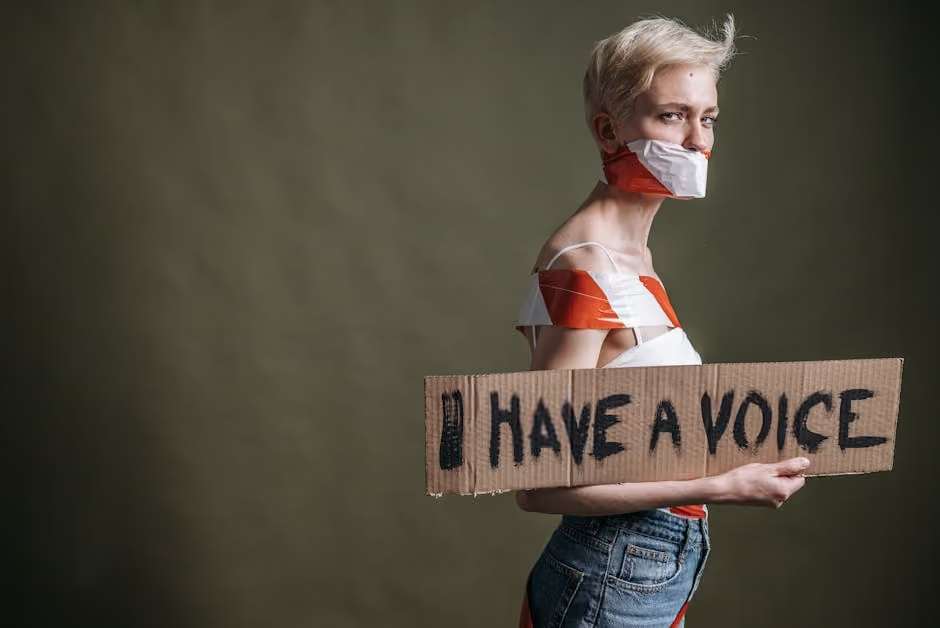
Voice to the voiceless is a concept often seen in discussions around poverty, inequality, and injustice. Yet, while it might seem straightforward, the phrase is loaded with nuance and complexity. It suggests giving a platform to those whose stories and experiences might not otherwise be heard. However, it also raises questions about power dynamics and representation. Why are certain voices deemed voiceless? And what happens when those with power speak on their behalf?
If you're interested in these questions, here are key points to consider:
- Poverty, inequality, and injustice often silence voices by creating barriers that limit participation and self-expression.
- Declaring oneself as "the voice" for others can unintentionally reinforce imbalances by implying some people cannot speak for themselves.
- True advocacy means supporting individuals in finding their own voices and creating platforms where they can share their stories.
These insights prompt us to rethink how we address issues affecting marginalized communities. They urge us to focus not just on retelling stories, but on empowering individuals to own their narratives.
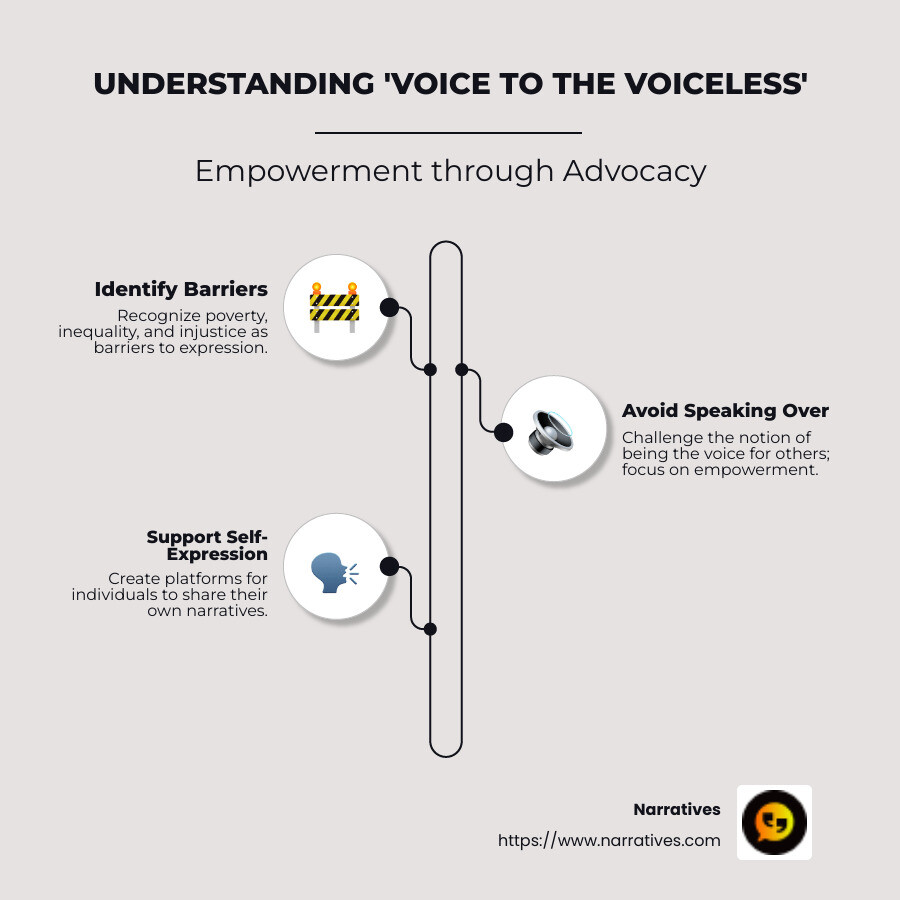
Simple guide to Voice to the voiceless:
The Origins of 'Voice to the Voiceless'
The phrase "Voice to the voiceless" has become a popular rallying cry in advocacy circles. But where did it come from, and what does it really mean? Let's break it down.
Social Construction
The concept of the "voiceless" is not inherent. It's a social construction. This means it's a label created by society. When we say someone is "voiceless," we imply that they lack the ability to speak up. But this isn't true. Most often, people are not voiceless by choice. Their voices are simply not heard due to societal barriers.
Take the example of the Democratic Republic of Congo. The narrative often focuses on conflict and tragedy. This overshadows the voices of Congolese people themselves. Judithe Registre, who worked in Eastern DRC, found that instead of speaking for these women, empowering them to tell their own stories was more impactful. Their voices were always there, just not amplified.
Marginalized Groups
Marginalized groups often find themselves labeled as "voiceless." Whether it's due to poverty, discrimination, or lack of access to resources, these groups face systemic barriers. These barriers silence them, not because they have nothing to say, but because society doesn't provide them a platform.
For instance, people with disabilities are often seen through the lens of needing help. Yet, as Meryl Alper points out, they are actively creating their own voices. They use technology and other means to express themselves. When we say we're giving them a voice, we might overlook the fact that they are already speaking.
Advocacy Through Authentic Voices
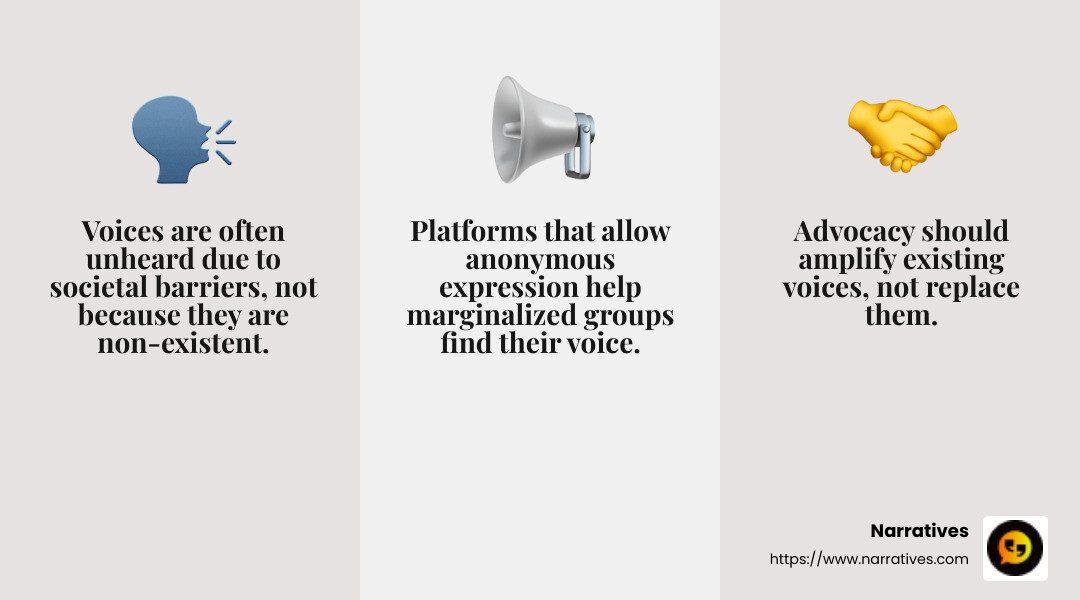
Advocacy should focus on amplifying these existing voices, not replacing them. When we step in as advocates, it's crucial to support and not overshadow. The goal is to create spaces where marginalized individuals can speak for themselves.
One successful example is the use of closed social media programs in schools. These platforms allow students to express ideas anonymously. This helps them find their voice without fear of judgment. It levels the playing field, giving everyone an opportunity to be heard.
In summary, the origins of "Voice to the voiceless" lie in addressing systemic silencing. However, true advocacy involves recognizing the power of authentic voices. It's about helping people amplify their own stories rather than telling the stories for them.
Next, we'll explore how power dynamics and societal norms play into the concept of voicelessness.
The Power Dynamics of Voicelessness
When we talk about "Voice to the voiceless," we're diving into a complex web of power dynamics and societal norms. At the heart of this issue are the systems that decide whose voices get heard and whose do not.
Challenging the Concept
The idea of being "voiceless" is often a product of societal structures. These structures can be oppressive, ensuring that only certain voices are amplified. This isn't just about who is speaking, but about who is being listened to and valued. As Arundhati Roy aptly puts it, “There’s really no such thing as ‘the voiceless.’ There are only the deliberately silenced, or the preferably unheard.”
To truly challenge this concept, we need systematic changes. This means going beyond symbolic gestures. It's not enough to just give people a platform; we need to dismantle the barriers that prevent them from using it effectively. This involves rethinking how we approach advocacy and representation.
Reimagining Power Structures
Reimagining power structures means shifting from a mindset of giving a voice to one of amplifying existing voices. Every individual has a voice, but not everyone has the agency to use it freely. Empowerment comes from creating environments where all voices can be heard and respected.
Consider the approach of Women and Girls Lead Global in their film Girls Connected. Instead of narrating the stories of young women, they let the women tell their own stories. This approach not only amplifies their voices but also challenges the existing power dynamics that often silence them.
Empowerment also involves recognizing and valuing the voices of those who have been marginalized. By doing so, we can begin to create change. This requires a collective effort to listen, learn, and engage with these voices in meaningful ways.
In summary, addressing the power dynamics of voicelessness involves both challenging existing concepts and reimagining power structures. It's about creating a world where all voices are valued, heard, and have the power to effect change.
Next, we'll explore how we can take a new approach to "Voice to the voiceless" by focusing on community-driven storytelling and engagement.
Voice to the Voiceless: A New Approach
In today’s complex world, "Voice to the voiceless" involves more than just providing a platform for unheard voices. It's about creating a space where storytelling becomes a tool for empowerment and community-driven change.
Listening and Learning
At the core of amplifying voices is the ability to listen and learn. This isn't just about hearing words; it's about understanding the context and emotions behind them. True engagement requires empathy. By genuinely listening, we can better comprehend the challenges faced by marginalized communities and work towards meaningful solutions.
In the classroom, for instance, programs like Edmodo have shown how technology can be used to encourage quieter students to express themselves freely. By allowing students to communicate anonymously, it creates an environment where ideas can be shared without fear of judgment. This approach highlights the importance of understanding and adapting to different communication needs.
Amplifying Authentic Voices
The goal is to amplify authentic voices, not to speak on behalf of others. This means recognizing the power of co-speakers—those who stand alongside marginalized individuals, lending their influence to lift real stories. In the film Girls Connected, young women narrate their own stories, showcasing the power of personal narratives in challenging societal norms.
Authentic representation matters. It ensures that the stories being told reflect the real experiences of those involved. This not only increases the influence of these narratives but also fosters genuine connections and understanding.
Balancing Tragedy and Resilience
In storytelling, it's crucial to balance narratives of tragedy and resilience. While it's important to acknowledge the struggles faced by marginalized groups, focusing solely on their hardships can overshadow their strength and achievements.
Arundhati Roy reminds us to avoid oversimplifying complex stories. Instead, we should aim to paint a complete picture that includes both the challenges and the triumphs. This balanced narrative not only honors the resilience of individuals but also inspires others to engage and support these communities.
By focusing on community-driven storytelling and fostering an environment of empathy and understanding, we can transform the way we approach "Voice to the voiceless." Next, we'll dig into frequently asked questions about this concept, exploring its meaning and how we can effectively amplify underrepresented voices.
Frequently Asked Questions about Voice to the Voiceless
What does 'Voice to the Voiceless' mean?
"Voice to the voiceless" is a phrase often used to describe efforts to empower those who have been historically marginalized or overlooked. This involves not just speaking on behalf of these groups but creating opportunities for them to express themselves.
Meryl Alper, in her book Giving Voice: Mobile Communication, Disability, and Inequality, highlights how this concept can sometimes mask underlying structural inequalities. The phrase implies that certain groups inherently lack a voice, which isn't always the case. Instead, it's crucial to recognize that these voices have been silenced by societal structures, and the goal should be to amplify them, not replace them.
Who are considered the voiceless in society?
The term "voiceless" often refers to individuals or groups who are underrepresented or marginalized in society. This can include people with disabilities, ethnic minorities, economically disadvantaged communities, and more. However, it's important to note that these groups do have voices; they may just not be heard due to systemic barriers.
For instance, in the disability community, narratives are often controlled by those without disabilities, leading to what Meryl Alper describes as "inspiration porn." This term criticizes how stories of people with disabilities are sometimes used to inspire others, rather than to genuinely share their experiences and perspectives.
How can we effectively amplify underrepresented voices?
Amplifying underrepresented voices involves several key actions:
Listen and Learn: Before speaking for others, it's crucial to listen to their stories and understand their needs. As Sarah Bessey points out, the issue is often not their "voicelessness," but rather our failure to listen.
Amplify Authentic Voices: Instead of speaking for marginalized communities, we should focus on amplifying their voices. This can be done by creating platforms where they can share their stories directly. The film Girls Connected is an example where young women tell their own stories, highlighting the power of personal narratives.
Balance Tragedy and Resilience: When sharing stories, it's important to balance the narratives of struggle with those of strength and resilience. This provides a more complete picture of the individuals and communities involved.
By focusing on these actions, we can ensure that the concept of "Voice to the voiceless" is more than just a symbolic gesture. It becomes a genuine effort to empower and uplift those who need it most.
Conclusion
The role of digital storytelling is more crucial than ever. At Narratives, we believe in the power of stories to drive change and inspire action. By partnering with non-profits, we aim to lift underrepresented voices and share their impact stories in a meaningful way.
Non-profit partnerships are at the heart of what we do. We collaborate with organizations that are committed to making a difference in their communities. Together, we create high-quality, emotionally resonant content that builds trust and increases visibility. Our goal is to ensure that these stories not only reach a wider audience but also lead to tangible support and change.
Through our work, we challenge the traditional notion of "Voice to the voiceless." We recognize that everyone has a voice; it's about creating the conditions for these voices to be heard. By focusing on storytelling that is community-driven, we help bring these voices to the forefront. This approach not only amplifies authentic voices but also fosters empathy and understanding.
We are committed to changing how stories are told in the digital age. Our strategy centers around owning storytelling-related keywords and differentiating through content focused on social impact. By investing in long-term, high-intent content, we aim to build consistent, organic traffic that supports lead generation and brand awareness.
As we continue to work with purpose-driven organizations, we invite you to explore how our digital storytelling services can help amplify your mission. Learn more about our media services here.
Together, let's create a world where all voices are valued and respected.


.avif)